EU Survival Kits: Hype or Essential Preparedness?

Water, food, medications... Recently, Hadja Lahbib, the European Union Commissioner for Equality, Preparedness, and Crisis Management, unveiled a survival kit designed to ensure self-sufficiency for 72 hours during an emergency situation.
This should include photocopied ID documents, money, a battery-powered radio, a charger along with a spare phone battery, a flashlight, matches and a lighter for use during outages, plus a first aid kit, water, food supplies, and some board games to keep occupied.
"Obviously, everyone hopes they will never need it, but in cases involving floods, storms, fires, or anything else, it’s wise to be somewhat prepared," said Danish Member of European Parliament (Renew Europe) Stine Bosse to Euronews.
'War hysteria'?
However, the initiative, which is part of the Commission’s 30 proposals aimed at enhancing the Union’s readiness for natural disasters, geopolitical conflicts, or cyberattacks, has faced criticism as well.
The far-right contends that Brussels is fostering an atmosphere of dread.
In the European Parliament, Kinga Gál, the First Vice-Chair of the far-right coalition called Patriots for Europe, takes it a step further by labeling it "war mania."
She told Euronews, 'It is causing panic and instilling fear without providing any benefit since we do not have wars within the European Union, and I sincerely hope this remains unchanged.'
Survival manuals
Nevertheless, the Commission's effort is not standalone as multiple European nations have already implemented comparable measures. Notably, those countries nearest to Russia appear to be the most well-prepared.
In January, Poland’s Defense Minister Władysław Kosiniak Kamysz stated that each family would get a survival handbook before the year ended. Then, in March, the Deputy Minister of Internal Affairs, Wiesław Leśniakiewicz, clarified that all citizens should be ready to fend for themselves for at least 72 hours without government support.
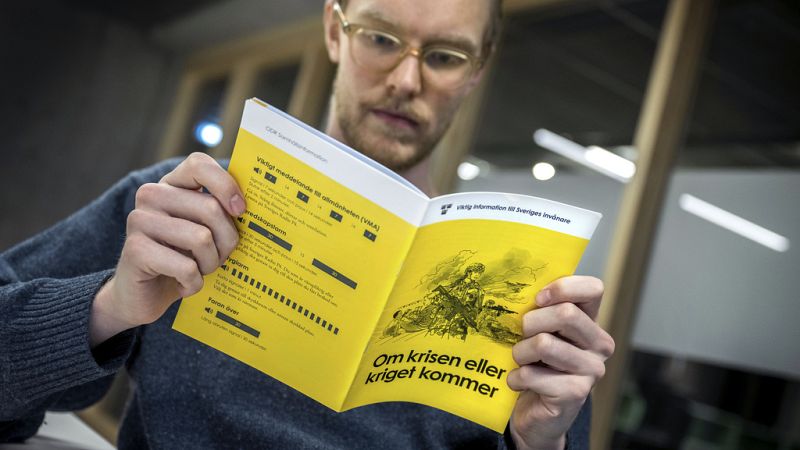
In Sweden, a vividly illustrated yellow pamphlet titled "In Case of Crisis or War" was revised and delivered to homes across the country on November 18, 2024. This document outlines steps for seeking safety during an airstrike and provides instructions on assembling a survival kit.
In November 2024, the Finnish Ministry of the Interior released an updated online resource aimed at helping citizens get ready for "emergencies and disruptions" due to scenarios such as prolonged blackouts, communication breakdowns, significant meteorological occurrences, pandemics, or armed conflicts. A poll carried out in September revealed that 58% of Finland’s population has stocked up on essential provisions at home should a crisis arise.
"Pretending for potential dangers won’t increase their likelihood of occurring. Effective readiness ensures that individuals across Finland can collectively address these challenges," states Eriikka Koistinen, the Communication Director at the Ministry of the Interior.
In 2022, Lithuania initiated a "knowledge saves" campaign aimed at increasing public understanding of civil defense measures and getting citizens ready for severe scenarios. Both the Minister of the Interior and representatives from emergency services provided guidance on assembling an essential emergency kit that should be readily accessible.
In June 2024, Estonian homes were provided with a manual for handling emergencies. This new edition updates the "Be prepared!" guide that was distributed in 2022.
In Latvia, the National Defence Service has released an updated "What to Do During a Crisis" pamphlet, ensuring families can handle situations independently for at least the initial 72 hours until vital assistance resumes.
'Anything can happen'
Now, others are drawing inspiration from the Baltic and Scandinavian approaches.
The French administration is set to release a pamphlet detailing steps to follow during emergencies.
In 2023, France released a visualization illustrating the components of a "survival kit" designed for use over 72 hours during a "significant catastrophe." Unlike Sweden’s guide, which focuses on preparing individuals for potential warfare scenarios, this emergency kit from France primarily aims to equip citizens against flooding events, as reported by multiple French news outlets.
In 2021, the German federal government released content for a survival kit after experiencing devastating floods and dealing with the Covid-19 pandemic.
In Belgium, the National Crisis Centre recommends that citizens acquire survival kits and sign up for the BeAlert website to get warning notifications. Additionally, plans are underway to launch an awareness initiative aimed at enhancing community toughness.
In Spain, First Vice-President and Minister of Finance María Jesús Montero stated that her focus is on promoting peace but also acknowledged it’s "reasonable" to be prepared for the most adverse situation.
"Anything can occur, and in Finland, where I hail from, we've always been accustomed to thinking this way," said Anna-Maja Henriksson, a Finnish Member of the European Parliament (Renew Europe), to Euronews.
She remarked, 'I think people underestimate how unnerving this can be. Actually, I feel quite the contrary since being ready means knowing you'll manage whatever happens.'